From Powerplay to Death Overs: IPL 2026 Orange Cap Leader Analysis
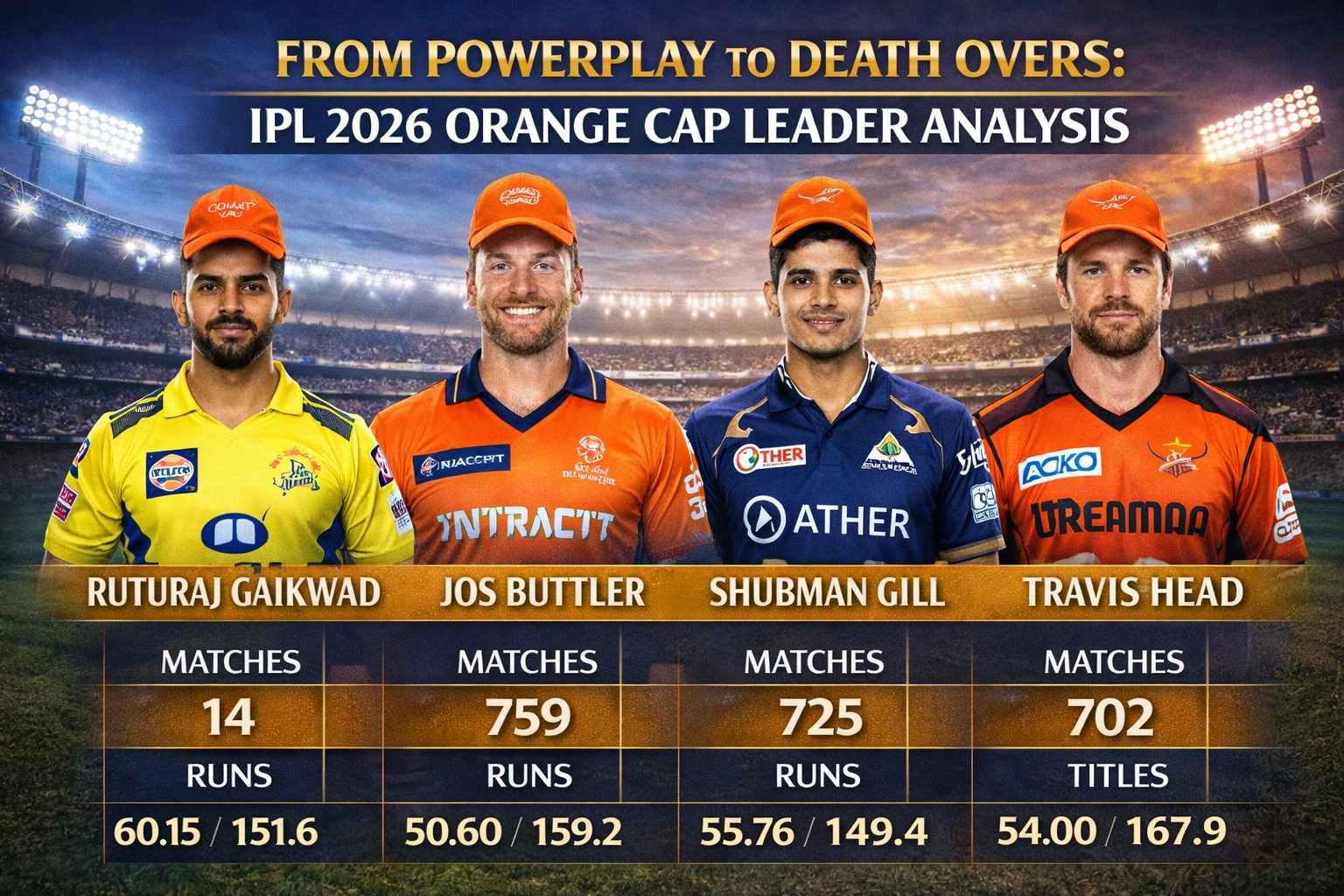
The race for the Orange Cap in the Indian Premier League is not just about scoring the most runs—it is about dominating every phase of a T20 innings. In IPL 2026, the leading run-scorers have evolved into complete batters who can accelerate in the Powerplay, stabilize during the middle overs, and explode at the death.
Table of Contents
Understanding the Phases of a T20 Innings
To evaluate Orange Cap leaders, we must divide a T20 innings into three critical phases:
1. Powerplay (Overs 1–6)
- Field restrictions favor aggressive batting
- High scoring rate expected
- Risk vs reward is crucial
2. Middle Overs (Overs 7–15)
- Spinners dominate
- Strike rotation becomes essential
- Anchoring roles are tested
3. Death Overs (Overs 16–20)
- Maximum acceleration required
- Boundary-hitting ability defines impact
- Pressure handling is critical
What Defines an Orange Cap Leader in IPL 2026?
The modern Orange Cap winner is not just a top scorer but a multi-dimensional batter who excels in:
- Consistency across matches
- Strike rate above 140+
- Ability to play spin and pace equally well
- Match-winning contributions under pressure
- Adaptability to different pitch conditions
Top IPL 2026 Orange Cap Contenders – Phase-Wise Analysis
Virat Kohli (Royal Challengers Bangalore)
Powerplay Dominance
Kohli has refined his Powerplay approach, balancing caution with calculated aggression. His ability to find gaps ensures a strong start without unnecessary risks.
Middle Overs Mastery
One of the best in rotating strike, Kohli maintains momentum during spin-heavy phases. His low dot-ball percentage is a key advantage.
Death Overs Evolution
Unlike earlier seasons, Kohli has improved his finishing, adding innovative strokes to accelerate in the final overs.
Shubman Gill (Gujarat Titans)
Powerplay Efficiency
Gill’s timing and shot selection make him one of the most reliable openers. He scores quickly without appearing risky.
Middle Overs Control
He anchors the innings, ensuring stability while keeping the scoreboard ticking.
Death Overs Growth
Gill has added power-hitting to his game, making him a complete T20 batter.
Jos Buttler (Rajasthan Royals)
Powerplay Impact
Buttler is among the most destructive Powerplay batters, often changing games within the first six overs.
Middle Overs Flexibility
He can either anchor or attack depending on match conditions.
Death Overs Explosiveness
Buttler’s ability to clear boundaries consistently makes him a lethal finisher.
KL Rahul (Lucknow Super Giants)
Powerplay Stability
Rahul prioritizes wicket preservation, ensuring a solid foundation.
Middle Overs Anchoring
He plays a classical anchor role, building innings with precision.
Death Overs Acceleration
While sometimes criticized for slow starts, Rahul can accelerate effectively when required.
Ruturaj Gaikwad (Chennai Super Kings)
Powerplay Timing
Gaikwad relies on elegant stroke play rather than brute force.
Middle Overs Consistency
He maintains a steady run flow, minimizing risks.
Death Overs Contribution
His ability to shift gears late makes him a valuable asset.
Phase-Wise Statistical Insights (IPL 2026 Trends)
Powerplay Trends
- Strike rates above 150 are common among top scorers
- Openers dominate Orange Cap standings
- Boundary percentage is highest in this phase
Middle Overs Trends
- Strike rotation separates elite batters from average ones
- Spin adaptability is crucial
- Dot-ball reduction leads to higher totals
Death Overs Trends
- Strike rates often exceed 180
- Finishers influence match outcomes significantly
- Batters with 360-degree shot range dominate
Key Metrics Behind Orange Cap Success
1. Strike Rate vs Consistency Balance
Players who maintain both high strike rates and consistent scoring lead the charts.
2. Boundary Percentage
Top batters maximize boundaries without taking excessive risks.
3. Dot Ball Percentage
Lower dot-ball percentage directly correlates with higher run totals.
4. Match Impact
Runs scored in winning causes carry more value than aggregate runs.
Tactical Evolution of IPL Batting in 2026
IPL 2026 reflects a shift in batting philosophy:
- Aggression is no longer limited to Powerplay
- Anchors now score at higher strike rates
- Finishers are becoming all-phase players
- Data-driven strategies influence shot selection
Who Has the Edge for Orange Cap in IPL 2026?
Based on current trends:
- Virat Kohli – Consistency across all phases
- Jos Buttler – Explosive match-winning ability
- Shubman Gill – Balanced modern T20 approach
These players combine technique, temperament, and adaptability, making them strong contenders.
Conclusion
The Orange Cap race in IPL 2026 is a reflection of modern T20 evolution. From Powerplay aggression to death-over finishing, the most successful batters are those who adapt, innovate, and dominate every phase of the game.
As the tournament progresses, expect the leaderboard to shift based on form, match situations, and team strategies. However, one thing remains certain—the Orange Cap will belong to the batter who masters all three phases of a T20 innings.
What is the Orange Cap in IPL?
The Orange Cap is awarded to the highest run-scorer in the IPL season.
Which phase is most important for Orange Cap contenders?
All phases are important, but consistency across Powerplay, middle overs, and death overs is key.
Who are the top Orange Cap contenders in IPL 2026?
Virat Kohli, Shubman Gill, and Jos Buttler are among the leading contenders.
Why is strike rate important in T20 cricket?
A higher strike rate ensures faster scoring, increasing match-winning impact.
Can a middle-order batter win the Orange Cap?
Yes, but openers usually have an advantage due to more balls faced.