From Legends to Young Stars – The Evolution of the FIFA World Cup
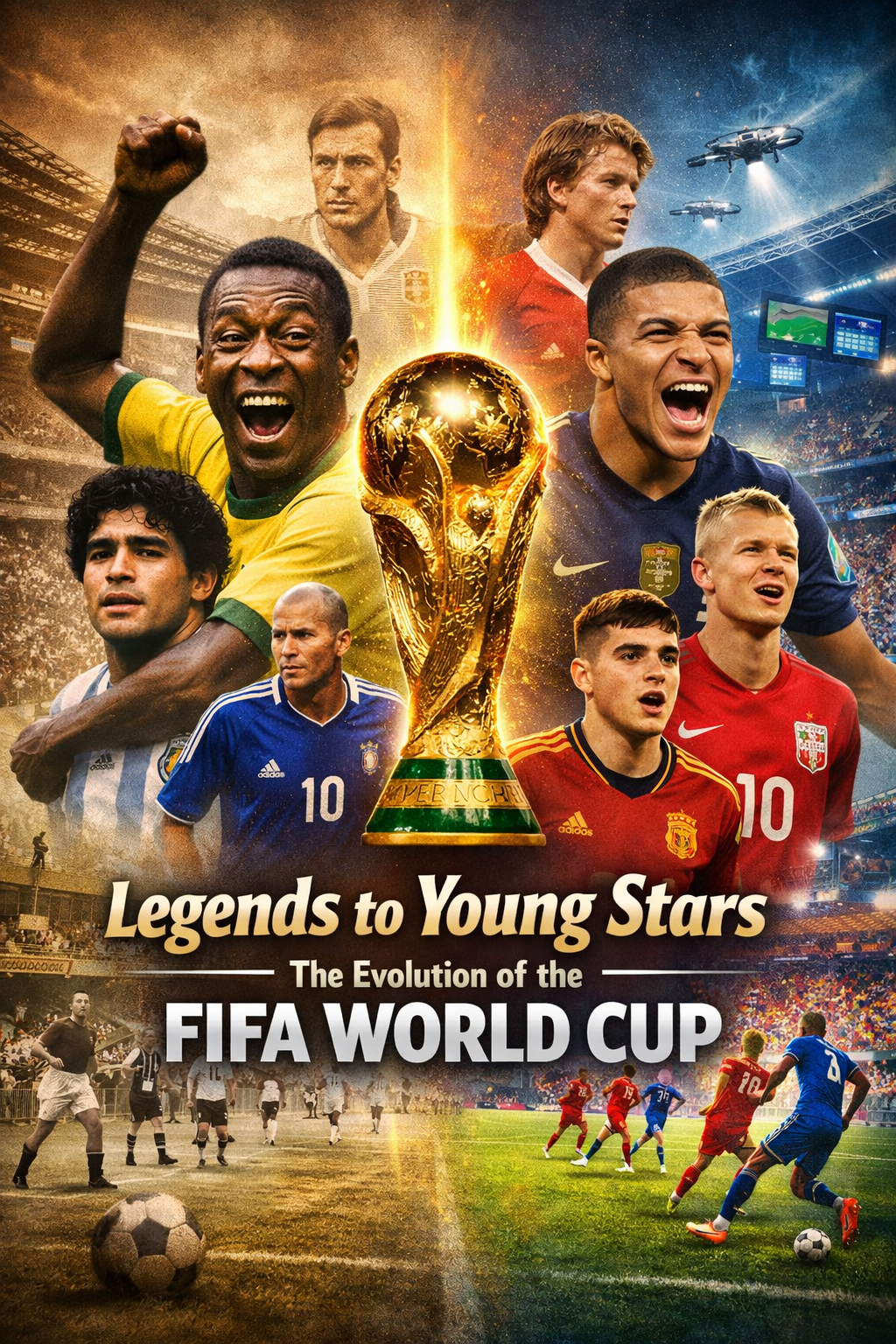
Football isn’t just a sport — it’s emotion, identity and history woven into 90 minutes of magic. And no tournament captures that magic better than the FIFA World Cup. From black-and-white broadcasts to ultra-HD global spectacles, from iconic legends to fearless young stars, the World Cup has evolved dramatically over nearly a century.
In this deep and human analysis, let’s examine how the tournament has transformed — tactically, culturally, commercially and emotionally.
Table of Contents
The Birth of a Global Dream
The first World Cup was held in 1930 in Uruguay. At the time, international travel was difficult, participation was limited, and the game was simpler. There were no sponsorship giants, no VAR, no social media hype — just pure football.
In its early decades:
- Teams relied heavily on physical strength.
- Tactical systems were basic (like the 2-3-5 formation).
- Players were local heroes rather than global superstars.
Yet even then, the tournament created legends whose names still echo in history.
The Era of Legends (1950s–1990s)
This was the golden period when football icons shaped the identity of the World Cup.
The Magicians & Game Changers
- Pelé – The teenage sensation who won the World Cup at just 17.
- Diego Maradona – The genius who carried Argentina in 1986.
- Johan Cruyff – The face of Total Football.
- Zinedine Zidane – The elegant maestro of 1998.
What Defined This Era?
- Individual brilliance dominated tactics.
- Fewer substitutions meant players carried responsibility.
- Defensive systems were evolving, but creativity ruled.
Football was romantic. Stars became national saviors. Winning the World Cup meant immortality.
The Commercial & Tactical Revolution (2000–2014)
The new millennium changed everything.
Television deals exploded. Sponsorships grew massive. Fitness science advanced. Football became faster, smarter, and more tactical.
Tactical Shifts:
- High pressing and positional play emerged.
- Midfield control became crucial.
- Data analytics started influencing decisions.
The dominance of teams like Spain national football team (2010) showed that possession could win tournaments. Meanwhile, global icons like Lionel Messi and Cristiano Ronaldo turned football into a worldwide brand phenomenon.
The World Cup was no longer just a tournament — it was a billion-viewer global event.
The Rise of Young Superstars (2018–Present)
Modern World Cups showcase fearless youth.
Players now debut in their early 20s with:
- Advanced academy training
- Sports science backing
- Tactical awareness beyond their years
The 2018 and 2022 tournaments showed how young talent can dominate the world stage. Emerging stars play without fear, blending speed, creativity, and athleticism.
The evolution is clear:
Earlier: Experience won tournaments.
Now: Youth and tactical systems shape champions.
How the Game Itself Evolved
1️⃣ Tactical Evolution
- 2-3-5 ➝ 4-4-2 ➝ 4-3-3 ➝ Fluid hybrid systems
- False 9 roles
- Inverted fullbacks
- High defensive lines
2️⃣ Technology Impact
- Goal-line technology
- VAR
- Performance tracking systems
3️⃣ Physical & Mental Preparation
Modern players:
- Cover more distance
- Sprint more frequently
- Recover faster
- Work with sports psychologists
The game is faster, smarter, and more demanding than ever.
Cultural & Global Impact
The World Cup has also:
- United divided nations.
- Created unforgettable underdog stories.
- Inspired generations in Asia, Africa, and North America.
The upcoming 2026 edition hosted by United States, Canada, and Mexico will expand the tournament to 48 teams — marking a new chapter in inclusivity and globalization.
Legends vs Young Stars – A Comparison
| Factor | Legends Era | Modern Era |
|---|---|---|
| Playing Style | Individual brilliance | Tactical systems |
| Fitness | Natural ability | Scientific training |
| Fame | National hero | Global celebrity |
| Pressure | Media & fans | Social media + global scrutiny |
| Career Path | Local clubs | Global academies |
The Future of the FIFA World Cup
Looking ahead:
- Artificial intelligence may influence tactics.
- Player workload management will be crucial.
- Emerging football nations could break traditional dominance.
One thing, however, will never change — the emotion when a nation lifts the trophy.
Final Thoughts
From Pelé’s teenage magic to the fearless brilliance of modern young stars, the FIFA World Cup mirrors the evolution of football itself.
It has grown from a small international competition to the most powerful sport on earth. Yet at its core, it remains beautifully simple:
22 players.
A ball.
A billion dreams.
Has the World Cup become less romantic compared to the past?
Not necessarily. While commercialization increased, the emotional drama remains unchanged. Underdog stories and last-minute goals still define tournaments.
Are modern players better than past legends?
It’s difficult to compare eras. Modern players benefit from better training and science, but legends played with fewer protections and tougher conditions.
Why are young players succeeding earlier now?
Advanced academies, sports science, and early exposure to top-level competition prepare players faster than ever before.
How will the 48-team format change the tournament?
More teams mean greater global representation but also new tactical challenges and scheduling complexities.
Who had a bigger impact — Pelé or Messi?
Different eras, different challenges. Pelé globalized the sport; Messi mastered the modern tactical era.