From Heroes to Icons: Greatest FIFA World Cup Players of All Time
The FIFA World Cup isn’t just a football match — it’s the ultimate stage where pressure meets passion, and ordinary heroes transform into global icons. Every four years, the world watches as players carry the dreams of millions on their shoulders.
But what makes a World Cup player truly great? Is it goals? Leadership ? Tovermomente? Or the ability to stand up when the world is watching?
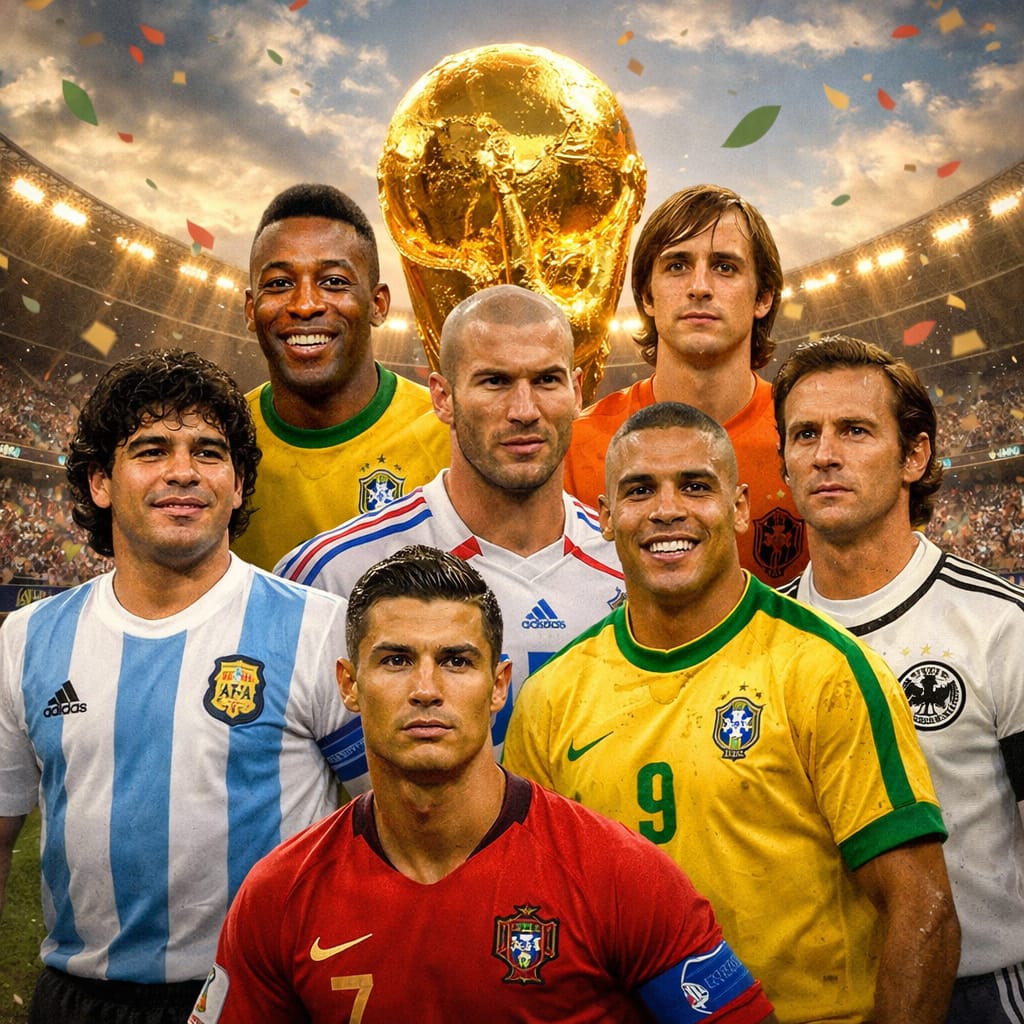
Let’s take a deep dive into the greatest FIFA World Cup players of all time — the heroes who have become icons and left footprints in football history forever.
Table of Contents
What Makes a World Cup Player Legendary?
Think about it.
Many players dominate club football. But the World Cup? That’s different. There are no second chances. No long seasons to recover from mistakes. Just seven matches to write your destiny.
A true World Cup legend:
- Performs under extreme pressure
- Delivers in crucial moments
- Inspires teammates
- Leaves unforgettable memories
That’s the difference between a good player and an icon.
Pelé – The King Who Conquered the World
When discussing greatness, you simply cannot ignore Pelé.
At just 17 years old, Pelé stunned the world in 1958. He scored twice in the final and announced himself as football’s future. But he didn’t stop there. He went on to win three World Cups (1958, 1962, 1970) — a record that still stands.
Pelé didn’t just score goals. He played with joy. With rhythm. With Brazilian samba in his boots.
He turned football into art.
Diego Maradona – A One-Man Army
If Pelé was poetry, Diego Maradona was fire.
The 1986 World Cup in Mexico belongs to him. One controversial “Hand of God” goal. One stunning solo goal against England that many call the greatest in history.
Maradona carried Argentina on his back. Every dribble felt like rebellion. Every pass, defiance.
He didn’t just win matches. He captured imagination.
Franz Beckenbauer – The Emperor
Leadership comes in many forms. For Germany, it came in the shape of Franz Beckenbauer.
Nicknamed “Der Kaiser,” Beckenbauer redefined the sweeper role. Calm, intelligent, composed — he won the World Cup as a player in 1974 and later as a coach.
He wasn’t flashy. He was dominant.
Sometimes greatness whispers instead of shouts.
Zinedine Zidane – Grace Under Pressure
Football can be brutal. But when Zinedine Zidane played, it felt gentle.
In the 1998 final, Zidane scored two headers against Brazil and delivered France their first World Cup title. His vision, balance, and elegance made football look effortless.
Even in 2006, despite the controversial ending, Zidane’s performances were masterful.
He proved that class never fades.
Ronaldo Nazário – The Comeback King
The story of Ronaldo Nazario is one of redemption.
After heartbreak in 1998, injuries nearly ended his career. But in 2002, he returned stronger, scoring eight goals and winning the Golden Boot.
Two goals in the final against Germany sealed Brazil’s fifth title.
That iconic haircut? Legendary.
That comeback? Even bigger.
Miroslav Klose – The Silent Record Breaker
You don’t always need flair to become iconic.
Miroslav Klose quietly became the all-time top scorer in World Cup history with 16 goals.
No drama. No spotlight chasing. Just consistency and clinical finishing.
Sometimes greatness is built brick by brick.
Lionel Messi – The Dream Completed
For years, critics said he needed a World Cup to cement his legacy. In 2022, Lionel Messi answered every doubt.
Seven goals. Magical assists. Leadership beyond numbers.
That final against France? Pure cinema.
Messi didn’t just win a trophy. He completed football.
Cristiano Ronaldo – The Relentless Competitor
While he never lifted the trophy, Cristiano Ronaldo remains one of the most influential World Cup players of the modern era.
His athleticism, drive, and hunger inspired a generation. He proved that hard work can rival natural talent.
Icons are not defined only by trophies — sometimes by impact.
Kylian Mbappé – The New Era Superstar
At 19, Kylian Mbappe won the 2018 World Cup. In 2022, he scored a hat-trick in the final.
Speed. Confidence. Fearlessness.
Mbappé represents the future — a bridge between legend and next generation.
The Evolution of World Cup Heroes
From black-and-white broadcasts to high-definition global streaming, the World Cup has evolved. And so have its heroes.
Earlier legends relied on creativity and instinct. Modern players combine athletic science, tactical intelligence, and global branding.
But one thing hasn’t changed — pressure.
The World Cup is still football’s ultimate test.
Moments That Create Icons
What truly transforms a hero into an icon?
- A last-minute goal
- A penalty shootout save
- A match-winning assist
- A captain lifting the trophy
In seconds, history is written.
And the world never forgets.
Beyond Football: Cultural Impact
World Cup icons influence more than just sport.
They shape fashion.
They inspire children.
They unite countries.
When Messi lifted the trophy, Argentina celebrated like a nation reborn. When Maradona won in 1986, it symbolized hope.
Icons become symbols.
Why the World Cup Defines Legacy
Club football builds careers.
The World Cup builds immortality.
You can win league titles every year. But one unforgettable World Cup performance? That’s eternal.
That’s why players dream of this stage.
Conclusion: From Heroes to Icons
The journey from hero to icon isn’t easy. It requires talent, courage, resilience, and a moment of destiny.
From Pelé’s brilliance to Maradona’s magic, from Zidane’s elegance to Messi’s fairytale — the FIFA World Cup continues to crown legends.
And somewhere, right now, a young player is training, dreaming of becoming the next icon.
Because in football, history is never finished.
Who is considered the greatest FIFA World Cup player of all time?
Pelé and Diego Maradona are often considered the greatest due to their iconic performances and World Cup victories. Modern fans also include Lionel Messi after his 2022 triumph.
Who has scored the most goals in World Cup history?
Miroslav Klose holds the record with 16 goals across four tournaments.
Why is the World Cup more important than club football?
The World Cup represents national pride and global competition, making it the highest honor in international football.
Can a player become a legend without winning the World Cup?
Yes. Players like Cristiano Ronaldo became global icons through impact, consistency, and influence despite not winning the tournament.
Who is the next potential World Cup icon?
Kylian Mbappé is widely seen as the next superstar capable of dominating future World Cups.