How the Tata IPL Auction Works: Rules, Purse & Player Selection Explained
The Indian Premier League is not only the most popular T20 cricket league in the world, but also one of the most financially powerful sporting leagues. A major reason behind its success is the IPL auction, where franchises build their teams by bidding for the best cricketing talent from across the globe.
Every season, the auction attracts millions of viewers for its dramatic bidding wars, surprise purchases, and record-breaking offers. Behind the excitement, however, lies a structured system of rules, salary caps, player categories and strategic decisions.
Table of Contents
What Is the Tata IPL Auction?
The IPL Auction is a player selection event where the ten franchises of the Indian Premier League compete to sign players for the upcoming season.
Each team builds its squad through a bidding process, similar to auctions in other sports leagues.
Main Objectives of the Auction
- Build a balanced team
- Fill specific roles in the squad
- Stay within the salary cap
- Invest in future talent
The auction ensures that talent is distributed evenly across teams, maintaining competitive balance in the league.
Types of IPL Auctions
1. Mega Auction
Mega auctions usually occur every 3–4 years.
During this auction:
- Teams can retain only a limited number of players
- Most players return to the auction pool
- Franchises rebuild their squads almost from scratch
Mega auctions often produce the biggest surprises and record-breaking deals.
2. Mini Auction
Mini auctions happen between seasons.
These auctions allow teams to:
- Replace injured players
- Fill missing roles
- Strengthen their squads
Mini auctions typically involve fewer players and smaller budgets compared to mega auctions.
IPL Auction Rules Explained
1. Salary Cap (Team Purse)
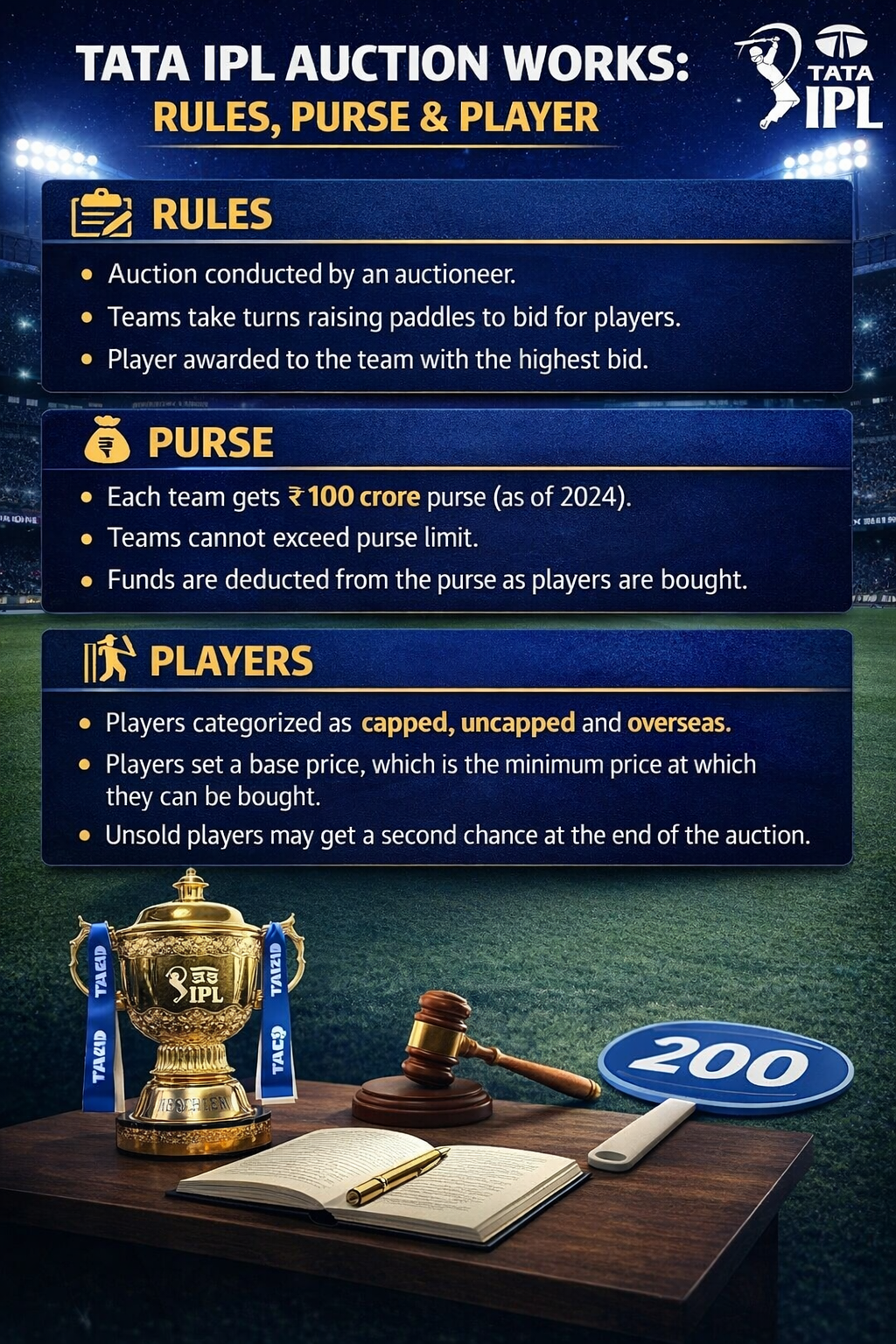
Every team is given a fixed budget known as the auction purse.
The purse is used to buy players during the auction.
Example
If a team has a purse of ₹100 crore, it cannot spend more than that amount on player contracts.
This rule ensures financial fairness among franchises.
2. Squad Size Rules
Each team must follow strict squad limits.
Minimum Players
18 players
Maximum Players
25 players
These squads include both Indian and overseas players.
3. Overseas Player Limit
Each IPL team can have:
- Maximum 8 overseas players in the squad
- Only 4 overseas players allowed in the playing XI
This rule promotes opportunities for Indian domestic players.
Player Categories in the Auction
Players register themselves in the IPL auction with a base price.
They are then placed into different categories.
Categories Include
- Batsmen
- Bowlers
- All-rounders
- Wicketkeepers
- Emerging players
Teams choose which category they want to bid from during the auction.
What Is Base Price?
The base price is the minimum amount for which a player can be purchased.
Examples of base prices include:
- ₹20 lakh
- ₹50 lakh
- ₹1 crore
- ₹2 crore
The bidding starts from the base price and increases as teams compete for the player.
The Bidding Process
The bidding process is the most exciting part of the auction.
Here’s how it works:
- The auctioneer announces the player’s name.
- Bidding begins at the base price.
- Teams raise the bid in increments.
- The highest bidder wins the player.
For example, when Mitchell Starc entered the auction, multiple teams competed aggressively before Kolkata Knight Riders secured him for a record-breaking price.
Retention Rules in IPL
Before a mega auction, teams can retain certain players.
Retention Limits
Teams are allowed to retain a limited number of players before the auction begins.
Retention helps franchises keep their core players.
Famous retained stars often include players like:
- MS Dhoni
- Virat Kohli
- Rohit Sharma
These players often represent their teams for many seasons.
Right to Match (RTM) Card
During some auctions, teams are allowed to use the Right to Match (RTM) card.
How RTM Works
If a team previously owned a player but did not retain him, they can use RTM to match the final auction price and buy him back.
This rule helps teams regain important players even if other teams bid for them.
Unsold Players in the Auction
Not every player gets purchased during the IPL auction.
If no team bids for a player, they are declared unsold.
However, unsold players can sometimes be bought later during:
- Replacement signings
- Special auction rounds
Even world-famous players have gone unsold in the past.
How Teams Select Players Strategically
IPL franchises follow complex strategies while building their squads.
1. Role-Based Selection
Teams look for players who can fill specific roles such as:
- Powerplay opener
- Death-over bowler
- Finisher
- Spin specialist
2. Balance Between Indian and Overseas Players
Since only four overseas players can play in a match, teams prioritize strong Indian talent.
3. Budget Management
Franchises must carefully manage their purse to ensure they have enough money to complete their squad.
Spending too much early in the auction can create problems later.
4. Long-Term Planning
Teams sometimes buy young players to develop them into future stars.
For example, young talents often grow into key players over time.
Why the IPL Auction Is So Exciting
The auction is popular worldwide because it combines:
- Sports strategy
- Financial drama
- Player rivalries
- Surprising decisions
Every year, fans witness unexpected moments such as record-breaking bids or superstar players going unsold.
These events make the IPL auction one of the most entertaining sporting events globally.
Impact of the IPL Auction on the Tournament
The auction shapes the entire IPL season.
A successful auction can:
- Strengthen a team’s chances of winning the title
- Improve squad depth
- Introduce new stars to the league
On the other hand, poor auction strategies can leave teams struggling throughout the season.
Conclusion
The Indian Premier League auction is much more than just a player bidding event—it is a complex system of strategy, finance, and talent evaluation.
From purse limits and retention rules to bidding wars and player categories, every aspect of the auction plays a crucial role in shaping the tournament.
Understanding how the IPL auction works helps fans appreciate the tactical decisions behind every franchise’s squad.
As the league continues to grow globally, the IPL auction will remain one of the most thrilling events in the world of cricket.
What is the IPL auction purse?
The purse is the total budget given to each team to buy players during the auction.
How many players can an IPL team have?
Each team must have between 18 and 25 players in their squad.
How many overseas players can play in an IPL match?
A maximum of four overseas players can be included in the playing XI.
What happens if a player goes unsold in the IPL auction?
Unsold players can later be signed as replacement players or return in future auctions.
What is the RTM card in the IPL auction?
The Right to Match (RTM) card allows a team to match the highest bid for a former player and buy him back.