2030 FIFA World Cup: Host Countries, Venues, and Big Plans
The 2030 FIFA World Cup promises to be one of the most extraordinary editions in the history of football. It’s not just another tournament — it’s the centennial celebration of the World Cup, 100 years since the first game was played in 1930. This edition will be historic, global and unprecedented in scope and organization.
Table of Contents
1. A Historic Tournament
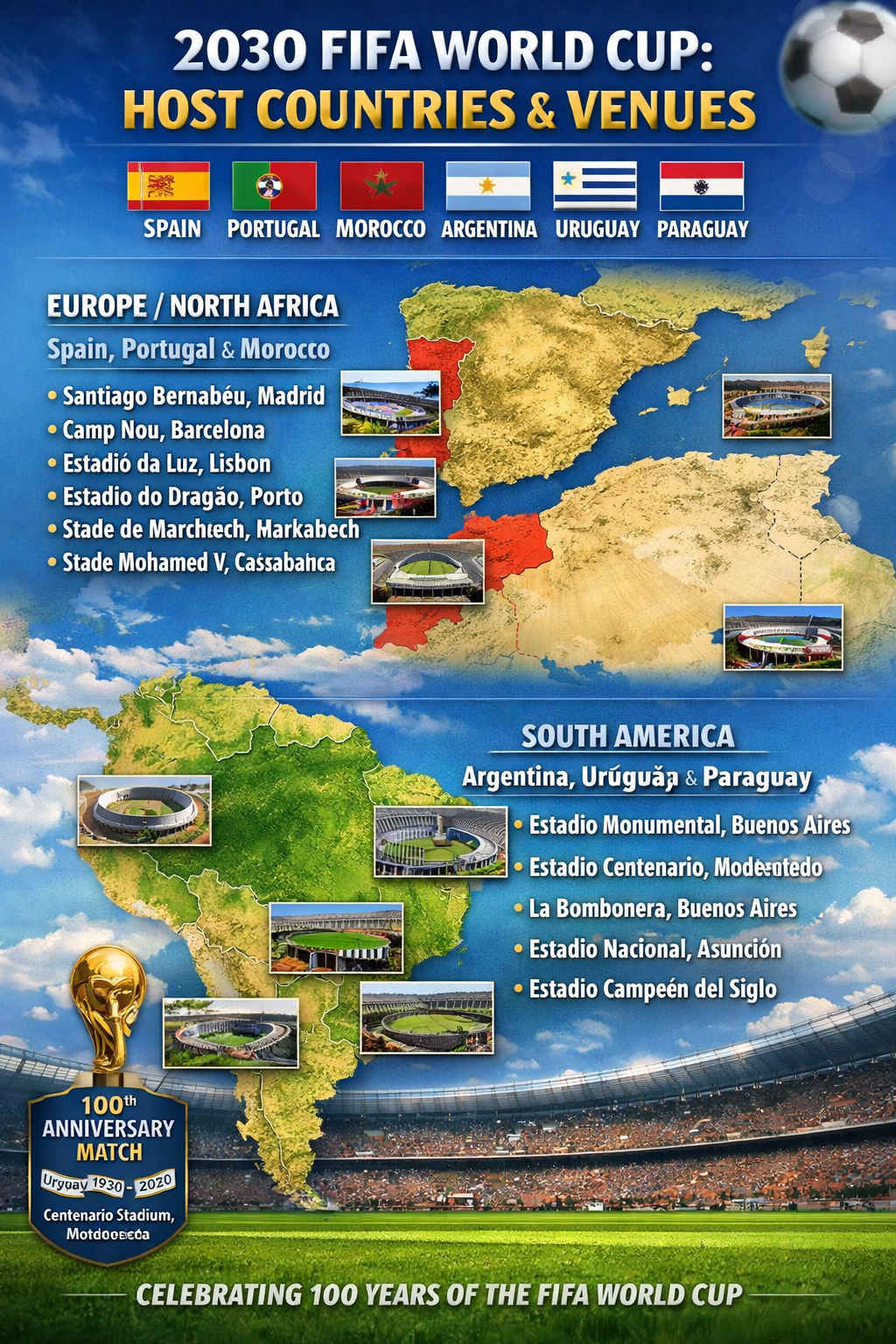
The 2030 FIFA World Cup will celebrate 100 years since the very first FIFA World Cup, held in 1930 in Uruguay — where national team football took its first major step onto the global stage. To honor this milestone, FIFA has designed a unique hosting plan involving six countries across three continents — something never seen before in World Cup history.
This expansion in global footprint reflects football’s incredible international growth and the desire to celebrate both its heritage and future.
2. Host Countries and Their Roles
The tournament will be hosted in six countries across three continents — Europe, Africa, and South America.
1. Morocco
Morocco is one of the main hosts and will stage matches across multiple cities and stadiums. This will be the first time that Morocco hosts the World Cup, marking a major achievement for African football.
2. Spain
Spain will co-host and is expected to host key matches, including possibly the final match — though the exact stadium is still to be confirmed. Spain’s deep football history and strong stadium infrastructure make it one of the tournament’s central hubs.
3. Portugal
Portugal joins as a co-host for the first time in its history, contributing modern world-class venues — including stadiums in Lisbon and Porto.
Centenary Hosts: Uruguay 🇺🇾, Argentina & Paraguay
To celebrate the 100-year anniversary of the World Cup’s inception in Uruguay in 1930, three South American nations will each host a centenary celebration match before the main tournament in Europe and Africa.
The special celebration matches will be symbolic — a tribute to the origins of football’s greatest competition.
3. Proposed Venues and Stadiums
FIFA has outlined proposed venues across the three main host nations. While discussions are ongoing, here’s a snapshot of potential locations:
Spain
Spain has selected up to 11 stadiums across major cities including:
- Camp Nou (Barcelona)
- Santiago Bernabéu (Madrid)
- La Cartuja (Seville)
- San Mamés (Bilbao)
…and others in Seville, Las Palmas, Madrid, Zaragoza, and more.
Portugal
Portugal will likely feature stadiums such as:
- Estádio da Luz — Lisbon
- Estádio do Dragão — Porto
- Estádio José Alvalade — Lisbon
Morocco
Morocco may include several stadiums, potentially among:
- Hassan II Stadium — Casablanca
- Adrar Stadium — Agadir
- Prince Moulay Abdellah Stadium — Rabat
- Ibn Battuta Stadium — Tangier
…and other major venues following infrastructure upgrades.
South America (Centenary Matches)
These opening games will be held in:
- Estadio Centenario — Montevideo, Uruguay (historic site of the 1930 final)
- Major stadiums in Argentina (likely Buenos Aires venues)
- National stadiums in Paraguay 🇵🇾 (such as Estadio General Pablo Rojas)
4. How the Tournament Will Work
The 2030 edition will include:
- Around 48 national teams, as is planned for post-2026 tournaments.
- A unique centenary opening segment in South America, followed by the main tournament in Morocco, Spain, and Portugal.
- Matches across different cities and regions, offering a diverse cultural and football experience.
There’s also discussion of a one-off expansion to 64 teams to celebrate the centenary — though this is still under consideration by FIFA.
5. Why This Edition Is Unique
A Century of Football
This World Cup holds emotional significance as the first took place in 1930. The inclusion of Uruguay, Argentina, and Paraguay for celebration matches creates a narrative across generations of football fans.
Three Continents, Six Hosts
No previous World Cup has been hosted across three continents. This reflects football’s truly global reach and increases fan participation worldwide.
Stadium Diversity
From iconic venues in Spain to emerging stadiums in Morocco — the tournament will showcase football infrastructure from traditional powerhouses and rising football nations alike.
6. Big Plans and Preparations
Centenary Celebrations
The opening match at Estadio Centenario — where the first World Cup final was held — will be one of the most anticipated moments in football history.
Infrastructure Investments
Host nations are planning major investments:
- Morocco is upgrading stadium capacity, transport links, airports, and tourist facilities.
- Spain and Portugal are modernizing existing stadiums and fan facilities to meet FIFA standards.
Global Fan Engagement
Fans will travel across continents, making 2030 one of the most culturally vibrant World Cups ever — spanning new food experiences, music, traditions, and global unity.
7. Challenges to Watch
Though the plans are exciting, some challenges remain:
Venue Upgrades
Certain stadiums may need renovations to meet FIFA standards — especially in Africa and South America.
Logistics
Travel across continents will be a major undertaking for teams and fans alike.
Format Decisions
A potential expansion to 64 teams could double the number of matches, requiring careful scheduling and logistics planning.
8. What It Means for Football Fans
The 2030 World Cup is a once-in-a-lifetime global celebration — uniting football heritage with modern spectacle. Fans can expect:
- Historic opening matches
- Matches across iconic venues
- Cultural diversity and festivities
- Expanded global participation
- Stories spanning generations of football lovers
Which countries will host the 2030 FIFA World Cup?
Morocco, Spain, and Portugal are the main hosts, with Uruguay, Argentina, and Paraguay hosting special centenary matches.
Why are Uruguay, Argentina, and Paraguay included?
They will host opening matches to celebrate the 100th anniversary of the first World Cup, which was held in Uruguay in 1930.
Where will the opening match be played?
The opening centenary match is expected at Estadio Centenario in Montevideo, Uruguay , the historic site of the first World Cup final.
How many teams will play in the 2030 World Cup?
The main tournament will feature 48 teams, though a proposed expansion to 64 teams has been discussed.
Will Spain host the final?
Spanish football officials have indicated that Spain is likely to host the final, though FIFA’s official venue decision is still pending