2030 FIFA World Cup Hosts Announced: Everything You Need to Know
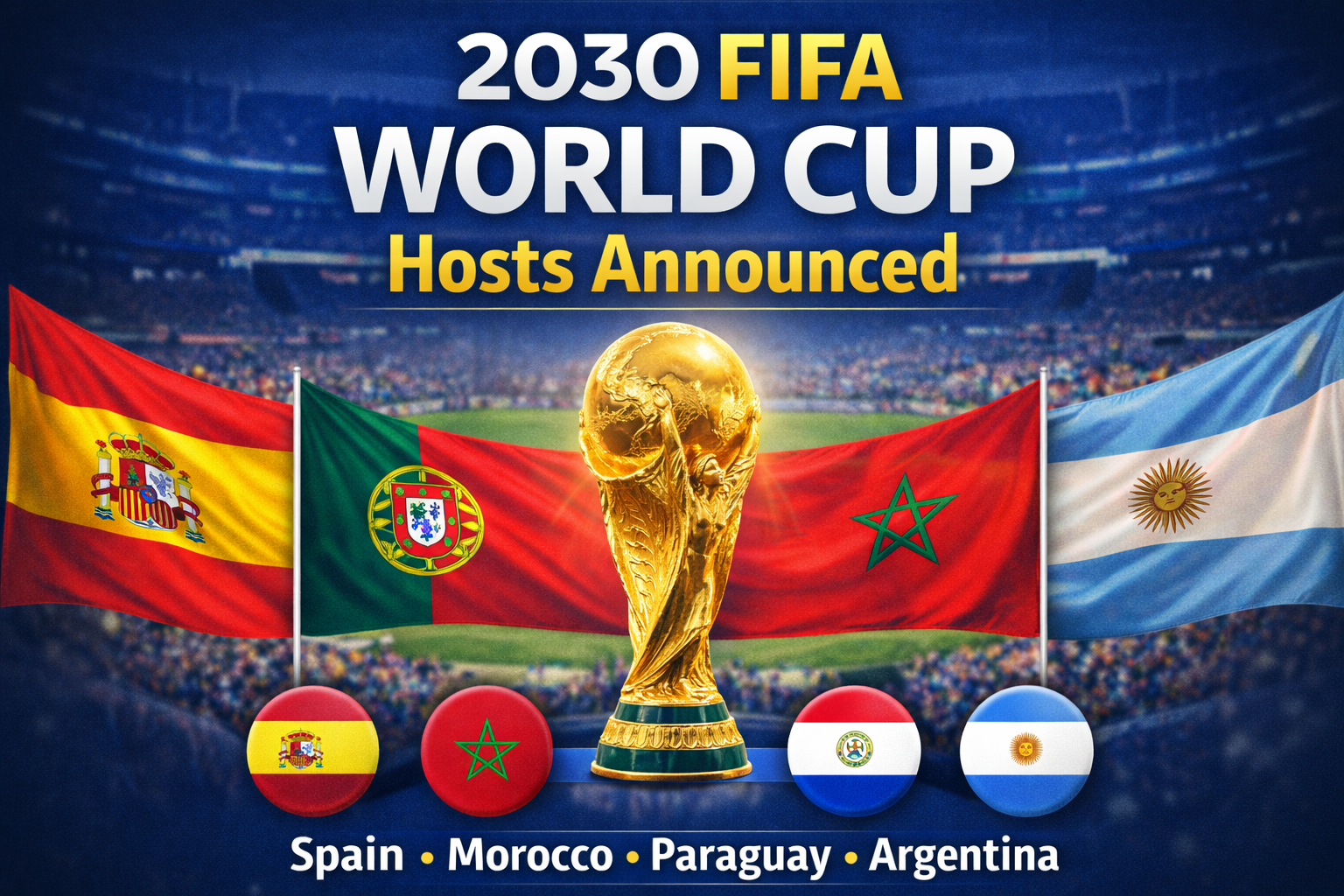
Football’s biggest global event—the FIFA World Cup—has announced its hosts for the 2030 edition, a landmark tournament marking 100 years since the very first World Cup in 1930. The host decision brought history, celebration, and a unique multi-nation format that reflects football’s global reach.
In this deep dive, we’ll explore:
- Who the hosts are
- Why this edition is historic
- Where matches will be held
- The selection process
- Proposed stadiums
- Key controversies and opportunities
- What football fans can expect
and more.
Table of Contents
1. A Historic Announcement
In December 2024, the FIFA officially confirmed that Morocco, Spain, and Portugal will jointly host the 2030 FIFA World Cup. In addition, three South American nations—Uruguay, Argentina, and Paraguay—will host special centenary celebration matches to honor the sport’s origins.
This announcement was made during an Extraordinary FIFA Congress, following a bidding process where the combined Morocco-Spain-Portugal bid became the consensus choice.
2. Why the 2030 World Cup Is Special
The 2030 edition will be the 24th FIFA World Cup and carries exceptional historical significance:
Centenary Celebration of the First World Cup
The very first FIFA World Cup was held in 1930 in Uruguay, making 2030 the 100th anniversary of the tournament’s inception. To honor this:
- Estadio Centenario in Montevideo, Uruguay—where the first final was played—will host a centenary match.
- Argentina and Paraguay will each host one additional centenary match.
This format celebrates football’s roots and recognizes South America’s foundational role in the sport’s history.
Expanded Footprint
The tournament will take place across three continents—South America, Africa, and Europe—bringing fans together in a way no previous World Cup has done.
3. The Host Countries and How It Works
Morocco
Morocco becomes one of the main co-hosts. The North African nation will help stage group matches, knockouts, and potentially deep-run fixtures depending on tournament structure. This will be a proud moment for African football.
Spain
Spain returns as a World Cup host decades after its sole hosting in 1982. Spanish cities with world-class stadiums—such as Madrid, Barcelona, and Seville—are expected to be utilized.
Portugal
Portugal will host World Cup matches for the first time. Cities like Lisbon and Porto are anticipated venues.
Uruguay, 🇦🇷 Argentina, 🇵🇾 Paraguay
Uruguay, Argentina, and Paraguay will host the first three matches in celebration of the tournament’s centenary. These matches won’t be fully part of the main host rotation, but they will be historic kickoff events.
4. Tournament Dates and Format
According to current planning:
- Opening Matches: Uruguay, Argentina, Paraguay (Centenary matches)
- Main Tournament Period: 8 June to 21 July 2030
- Capacity: 48 national teams
- Venues: Approximately 19 primary venues in Morocco, Spain, and Portugal plus the three centenary venues.
FIFA is exploring potential expansion to 64 teams for 2030, but the standard 48-team format remains the current framework.
5. Stadiums and Host Cities
While FIFA has not published a final list of all 2030 World Cup stadiums yet, proposals include famed grounds across the three main hosts, including:
Spain
- Some of UEFA’s most historic venues—likely including Camp Nou (Barcelona), Santiago Bernabéu (Madrid), and others.
Portugal
- Estádio da Luz and Estádio do Dragão are among the top candidates.
Morocco
- Hassan II Stadium (Casablanca), Prince Moulay Abdellah Stadium (Rabat), and others may be included.
South America (Centenary Matches)
- Estadio Centenario (Montevideo, Uruguay)
- Major venues in Buenos Aires (Argentina)
- National stadium in Asunción (Paraguay)
(Official stadium confirmation is expected as part of the detailed World Cup planning phase.)
6. Bidding and Selection Process
FIFA launched the bid process for the 2030 World Cup several years before the decision. Major bid groups included:
- Morocco–Spain–Portugal (successful bid)
- Egypt–Greece–Saudi-Arabia (initial proposal but not selected)
After bids were assessed, the FIFA Council recommended the Morocco-Spain-Portugal bid, and it was confirmed by the FIFA Extraordinary Congress.
7. What This Means for World Football
A Truly Global Tournament
The selection of three main hosts and three centenary venues makes this one of the most geographically diverse World Cups ever. It reflects:
- The growth of competitive football infrastructure outside traditional powerhouses
- FIFA’s effort to celebrate football history and its global footprint
Boost for Football Development
Hosting the World Cup across multiple countries:
- Encourages investment in infrastructure
- Enhances football development in Africa and Europe
- Offers marketing and tourism opportunities for host nations
A Cultural Celebration
Beyond sport, this World Cup will be a cultural celebration—lifting football’s heritage while spotlighting diverse regions and fanbases.
8. Key Challenges and Considerations
Every World Cup brings logistical challenges:
- Travel and Scheduling: Coordinating matches across three continents requires complex logistics.
- Venue Readiness: Host cities must meet FIFA’s stadium and infrastructure standards.
- Security and Fan Safety: Multi-nation hosting necessitates harmonized security protocols across borders.
- Costs and Sustainability: Financial planning and environmental considerations are key for successful execution.
Even for the 2026 World Cup, issues like funding and safety have already become topics of intense public discussion.
9. Controversies and Criticisms
Like major world sporting events, the 2030 World Cup has faced debate:
Criticism of Hosting Decisions
Some member associations criticized elements of the bid and selection process, arguing for more competitive bidding systems.
Debate over Stadium Selection Costs
There are ongoing discussions around stadium financing and investment in host communities.
However, many football supporters view the 2030 format as a historic and inclusive celebration.
10. What Fans Can Expect
- A unique opening ceremony celebrating football history
- Matches hosted across North Africa and Europe
- Historic centenary games in South America
- Expanded global fan engagement
- A celebration for football’s 100th anniversary
Fans should start planning travel and ticketing as official announcements emerge closer to the event.
Final Thoughts
The 2030 FIFA World Cup promises to be one of the most memorable editions in history. By sharing the tournament across continents and celebrating the centenary of the first World Cup, FIFA is creating a global event that honors football’s heritage while inspiring a new generation of fans.
Who are the main hosts of the 2030 FIFA World Cup?
Morocco, Spain, and Portugal will jointly host the tournament, with centenary matches in Uruguay, Argentina, and Paraguay.
Why does Uruguay host opening matches?
Uruguay will host the first centenary match to honor the 100th anniversary of the first World Cup played there in 1930.
When will the 2030 World Cup take place?
The main tournament is scheduled from 8 June to 21 July 2030.
How many teams will participate?
The tournament will feature 48 national teams.
Will stadiums be spread across continents?
Yes—venues will be in Europe (Spain, Portugal), Africa (Morocco), and South America (centenary hosts).
Were there other bids for hosting?
Yes—one notable bid came from Egypt, Greece, and Saudi Arabia but was not selected.