Historic Goals & Golden Eras: The Story of World Football
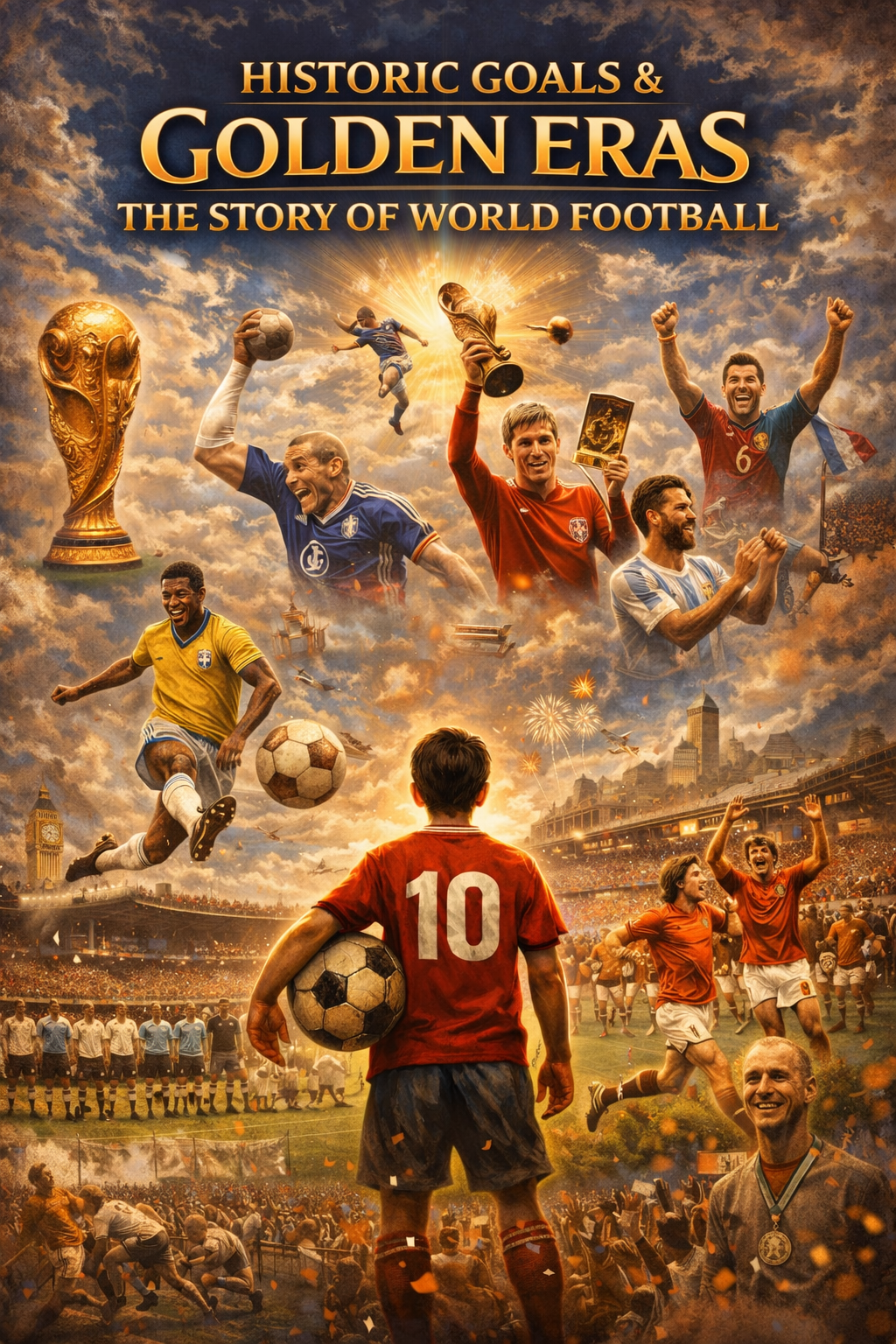
The history of football is written in moments — memorable goals, dominant teams and eras that have defined generations. From the first whistle of the FIFA World Cup to modern tactical masterpieces, world football has evolved through golden periods that have shaped the game’s identity.
This in-depth analysis explores the historical goals of football, its legendary eras, its iconic players, and the evolution that has turned it into the global phenomenon we know today.
Table of Contents
1. The Early Foundations of Global Football (1900–1930s)
The early 20th century marked football’s transformation from a European pastime to a global competition. With the establishment of FIFA in 1904 and the first World Cup in 1930, football stepped onto the world stage.
Uruguay’s victory in the inaugural World Cup set the tone for international competition. South America quickly became a powerhouse alongside Europe.
Q & A
Q: Why was the 1930 World Cup important?
A: It marked the beginning of international football supremacy and global recognition.
Q: Which regions dominated early football?
A: South America and parts of Europe led the early decades.
2. Brazil’s Golden Era and the Art of Attacking Football (1958–1970)
When discussing golden eras, Brazil’s dominance stands above many others. Led by the legendary Pelé, Brazil won the World Cup in 1958, 1962, and 1970.
The 1970 Brazilian team is often considered the greatest ever. Their attacking style, creativity, and fluid movement changed how the game was played.
Historic Goal Moment:
- Pelé’s header in the 1970 final.
- Carlos Alberto Torres’ stunning team goal in the same match.
Q & A
Q: Why is Brazil 1970 considered the best team ever?
A: Because of their attacking brilliance, technical excellence, and complete dominance.
Q: What made Pelé special?
A: His versatility, intelligence, and ability to perform on the biggest stage.
3. The Maradona Era – Passion and Controversy (1986)
The 1986 World Cup in Mexico belongs to one man: Diego Maradona.
In the quarterfinal against England, Maradona scored two of the most famous goals in history:
- The “Hand of God”
- The “Goal of the Century”
These moments captured both controversy and genius — perfectly symbolizing football’s emotional depth.
Q & A
Q: Why is Maradona’s 1986 performance legendary?
A: He carried Argentina almost single-handedly to World Cup glory.
Q: What is the ‘Goal of the Century’?
A: Maradona’s solo run past multiple England players before scoring.
4. Europe’s Tactical Revolution and Total Football (1970s–1990s)
While South America brought flair, Europe introduced tactical innovation.
The Netherlands’ “Total Football” in the 1970s revolutionized positional play. Later, Italy’s defensive mastery and Germany’s efficiency defined consistency.
Clubs also entered golden periods:
- AC Milan’s dominance in the late 1980s.
- Manchester United’s treble in 1999.
Historic Goal Moment:
- Zinedine Zidane’s volley in the 2002 Champions League final.
Q & A
Q: What is Total Football?
A: A tactical system where players interchange positions seamlessly.
Q: How did European football change the game?
A: Through discipline, organization, and tactical innovation.
5. The Messi–Ronaldo Era: Individual Greatness Redefined (2008–2022)
Modern football witnessed an unprecedented rivalry between Lionel Messi and Cristiano Ronaldo.
For over a decade:
- They dominated Ballon d’Or awards.
- Broke scoring records.
- Defined club football excellence.
Messi’s crowning moment came when he lifted the World Cup in 2022, completing his legacy.
Historic Goal Moments:
- Messi’s solo goals against Getafe and Real Madrid.
- Ronaldo’s bicycle kick against Juventus.
Q & A
Q: Why is the Messi vs Ronaldo rivalry historic?
A: Because both players maintained peak performance for over a decade.
Q: Who changed football more?
A: Messi redefined creativity; Ronaldo redefined athletic professionalism.
6. Historic Goals That Changed Football Forever
Football’s golden eras are remembered through iconic goals:
- Geoff Hurst’s hat-trick in 1966.
- Marco van Basten’s volley in Euro 1988.
- Andrés Iniesta’s World Cup-winning goal in 2010.
- Mario Götze’s extra-time winner in 2014.
Each goal carried emotional and historical weight, shifting narratives and defining generations.
Q & A
Q: Why do certain goals become historic?
A: Because of the stage, timing, and emotional significance.
Q: Are club goals as important as World Cup goals?
A: Yes, especially in major finals like the Champions League.
7. The Commercial and Global Era (2000s–Present)
Football today is more global than ever:
- Billion-dollar broadcasting deals.
- Social media influence.
- Youth academies across continents.
- Women’s football growth.
The sport now blends tradition with technology, using VAR, analytics, and sports science to improve performance and fairness.
Q & A
Q: Has commercialization harmed football?
A: While it has increased pressure, it has also expanded opportunities worldwide.
Q: What is the next golden era?
A: Likely a more global era featuring stars from Asia, Africa, and North America.
Conclusion: Why Football’s Story Never Ends
Historical goals and golden ages are chapters in an ongoing story. From Pelé’s art to Messi’s magic, from tactical revolutions to emotional finals, football is constantly reinventing itself.
The beauty of world football is not just in trophies — but in moments that unite billions of people. And when new stars rise, the next golden age is already being written.