The Complete History of the FIFA World Cup: From 1930 to Modern Glory
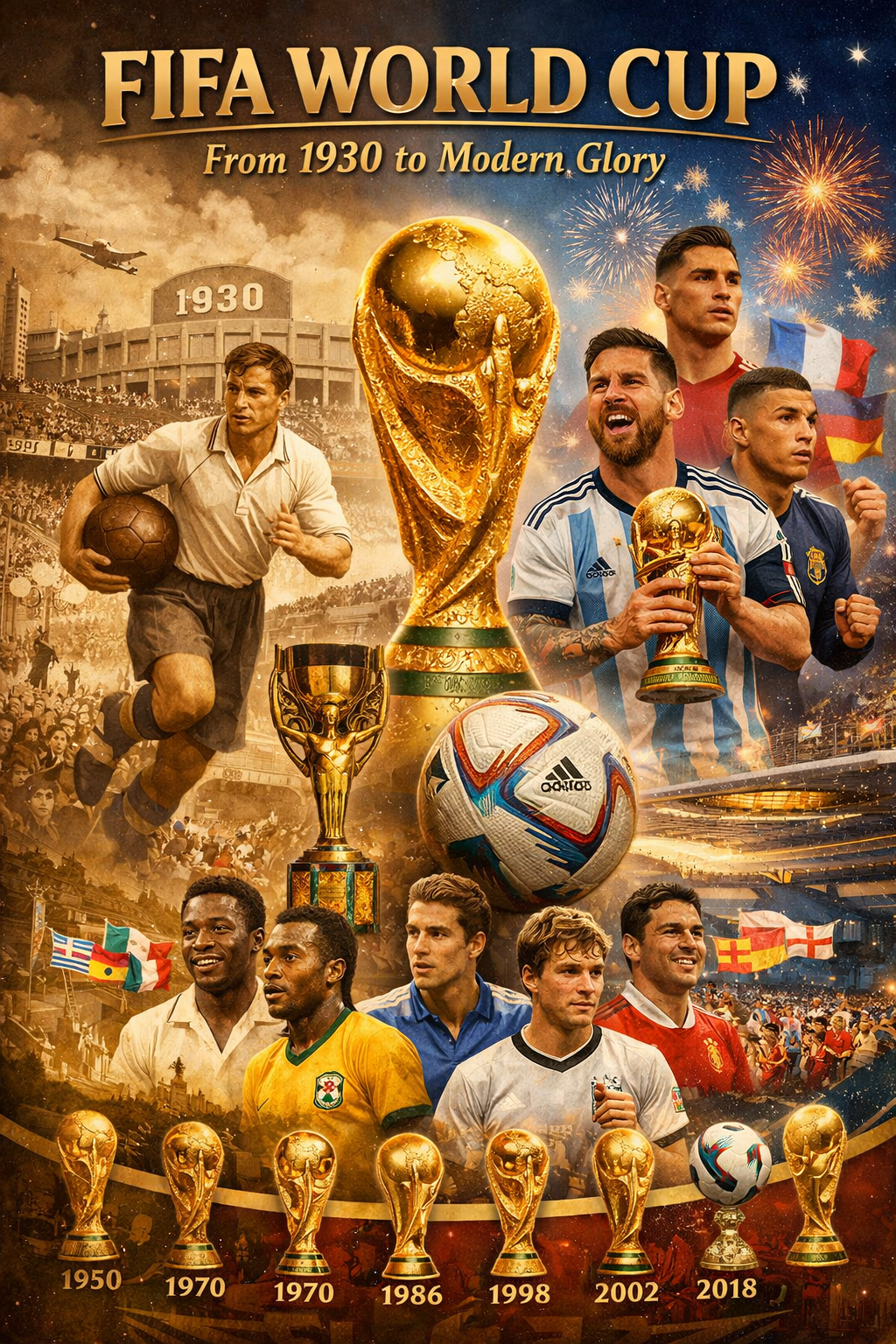
The FIFA World Cup is more than just a football tournament – it’s the heartbeat of the global game. Since its inception in 1930, the tournament has united nations, created legends and produced moments that have shaped sports history forever. From its early days in South America to its billion-viewers in modern times, the World Cup has evolved into the most prestigious tournament in international football.
The tournament, organized by FIFA (Fédération Internationale de Football Association), is held every four years and is the pinnacle of international competition.
Let’s take a deep dive into his remarkable journey.
Table of Contents
The Birth of a Global Tournament (1930–1950)
The first World Cup was held in 1930 in Montevideo, Uruguay. Only 13 teams participated because long-distance travel was difficult and expensive. Host nation Uruguay defeated Argentina 4-2 in the final to become the first-ever champions.
However, the tournament was interrupted by World War II. The 1942 and 1946 editions were cancelled, reflecting the global political tensions of the time.
In 1950, the World Cup returned to Brazil, producing one of the most shocking results in football history: Uruguay beat Brazil in the famous “Maracanazo” at the Maracanã Stadium.
The Rise of European Dominance (1954–1970)
Post-war Europe quickly became a powerhouse in international football.
- In 1954, West Germany stunned Hungary in the “Miracle of Bern.”
- In 1958, a 17-year-old Pelé led Brazil to glory, becoming the youngest World Cup winner.
- Garrincha dazzled the world in 1962.
- In 1966, England won their only World Cup on home soil.
- The 1970 World Cup in Mexico is widely regarded as one of the greatest tournaments ever, with Brazil’s attacking brilliance reaching its peak.
The 1970 Brazilian squad is often considered the greatest team in World Cup history.
Total Football and Tactical Evolution (1974–1990)
The 1974 tournament showcased the revolutionary “Total Football” philosophy led by Johan Cruyff and the Netherlands. Although they didn’t win, their tactical innovation changed the sport forever.
- Argentina lifted the trophy in 1978.
- The 1986 tournament in Mexico witnessed the genius of Diego Maradona, who scored both the controversial “Hand of God” goal and the stunning “Goal of the Century” against England.
- In 1990, West Germany claimed their third title.
This era highlighted how tactics, discipline, and strategy became as important as raw talent.
Global Expansion and Commercial Boom (1994–2010)
The 1994 World Cup in the United States marked a commercial breakthrough, attracting massive global audiences.
- France won their first title in 1998, inspired by Zinedine Zidane.
- Brazil triumphed in 2002 with Ronaldo Nazário leading the charge.
- In 2006, Italy won in a dramatic penalty shootout.
- The 2010 edition in South Africa became the first World Cup held on African soil, where Spain claimed their maiden title.
This period saw technological improvements, sponsorship growth, and worldwide broadcasting reach.
The Modern Era: Icons and Intensity (2014–2022)
The modern World Cup era has been defined by intense rivalries and legendary players.
- In 2014, Germany defeated Argentina in Brazil.
- France lifted their second trophy in 2018.
- The 2022 tournament in Qatar delivered one of the greatest finals ever, as Argentina defeated France in a thrilling match. Lionel Messi finally completed his career by winning the World Cup.
The 2022 final is already considered one of the greatest matches in football history.
Records and Legendary Achievements
- Brazil holds the record with five World Cup titles.
- Miroslav Klose is the all-time top scorer in World Cup history.
- Pelé remains the only player to win three World Cups.
These records highlight the tournament’s rich competitive legacy.
The Future of the FIFA World Cup
The tournament continues to evolve. The 2026 edition will expand to 48 teams and will be jointly hosted by the United States, Canada, and Mexico.
With advancements in VAR technology, analytics, and youth development programs, the future promises even greater competitiveness and global participation.
Conclusion
From Uruguay’s historic triumph in 1930 to Argentina’s dramatic victory in 2022, the FIFA World Cup has evolved into a global celebration of football excellence. It has survived wars, political tensions, and cultural shifts—yet its magic remains untouched.
The World Cup is not just about winning trophies; it is about dreams, unity, heartbreak, and unforgettable glory.
When was the first FIFA World Cup held?
The first tournament was held in 1930 in Uruguay.
Which country has won the most World Cups?
Brazil holds the record with five titles.
Who is the all-time top scorer in World Cup history?
Miroslav Klose of Germany holds the record.
Why is the 1970 World Cup considered special?
Brazil’s 1970 team is widely regarded as one of the greatest teams ever assembled.
How many teams will play in the 2026 World Cup?
The 2026 World Cup will feature 48 teams.
Why is the 2022 final considered historic?
Because it featured a dramatic showdown between Argentina and France, ending with Lionel Messi lifting the trophy after an extraordinary performance.