From Uruguay 1930 to Qatar 2022: The Epic Journey of the FIFA World Cup
The FIFA World Cup is the biggest stage in world football — a tournament where dreams are realized, legends are born, and nations are united. From humble beginnings in 1930 to the dramatic spectacle of 2022, the competition has grown to become the most watched sporting event on the planet.
The World Cup, organized by FIFA, is held every four years and represents the ultimate prize in international football. Let’s explore the epic journey from the origins in Uruguay to the unforgettable nights in Qatar.
Table of Contents
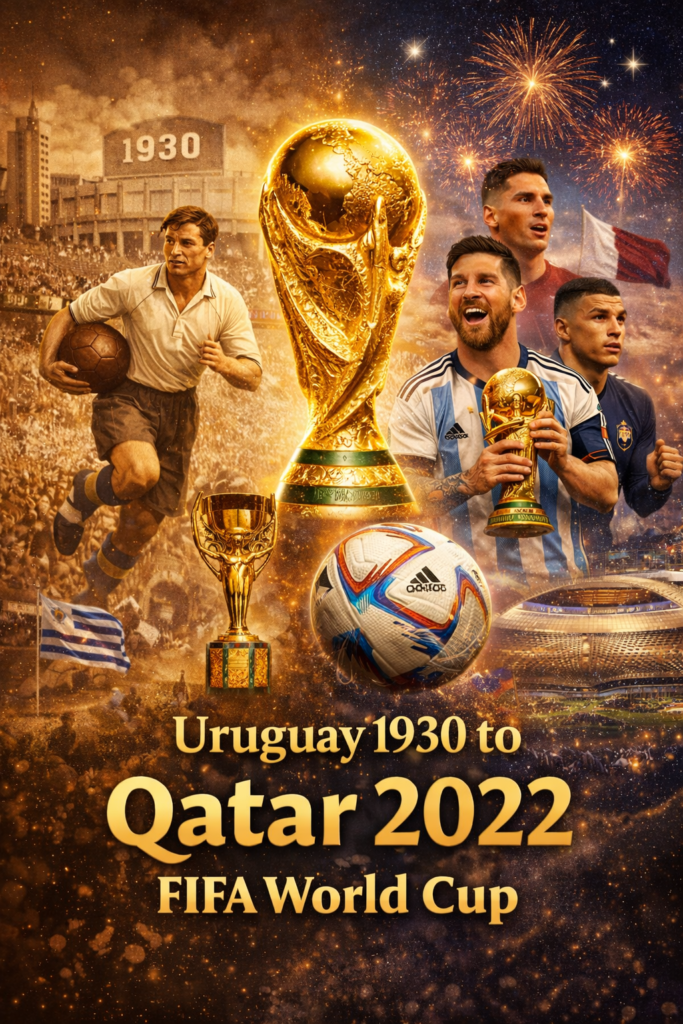
The Beginning: Uruguay 1930
The first World Cup was hosted in Uruguay in 1930. Only 13 teams participated, as travel across continents was challenging at the time. European teams hesitated due to long sea voyages.
The final, held in Montevideo, saw Uruguay defeat Argentina 4–2. The victory marked the birth of a global sporting tradition.
However, the tournament faced interruption during World War II, with the 1942 and 1946 editions canceled.
Post-War Revival and European Rise (1950–1970)
The tournament resumed in 1950 in Brazil, producing the historic “Maracanazo,” where Uruguay stunned the host nation in front of nearly 200,000 fans.
The following decades saw European and South American dominance:
- 1954: West Germany defeated Hungary in the “Miracle of Bern.”
- 1958 & 1962: Brazil, led by the young genius Pelé, captured back-to-back titles.
- 1966: England won their first and only World Cup.
- 1970: Brazil’s magical team in Mexico delivered one of the greatest performances in tournament history.
This era established football’s global appeal.
Tactical Revolution and Iconic Moments (1974–1990)
The 1974 World Cup introduced the world to “Total Football,” pioneered by the Netherlands and inspired by Johan Cruyff. Though they didn’t win, their style transformed football tactics forever.
In 1986, the tournament in Mexico belonged to Diego Maradona. His “Hand of God” and “Goal of the Century” against England remain two of the most talked-about moments in football history.
By 1990, West Germany lifted their third trophy, symbolizing the strength of European football.
Commercial Expansion and Global Popularity (1994–2010)
The 1994 tournament in the United States marked a turning point commercially. Massive television audiences and sponsorship deals expanded football’s global reach.
Key highlights:
- 1998: France won on home soil, inspired by Zinedine Zidane.
- 2002: Brazil claimed their fifth title, led by Ronaldo Nazário.
- 2006: Italy triumphed in Berlin.
- 2010: Spain lifted their first World Cup in South Africa — the first World Cup held on African soil.
This period solidified the tournament as a global festival of sport and culture.
The Modern Era: Drama, Records, and Redemption (2014–2022)
The modern World Cup has delivered intense competition and unforgettable drama.
- 2014: Germany defeated Argentina in Brazil.
- 2018: France captured their second title in Russia.
- 2022: Hosted in Qatar, the tournament culminated in one of the greatest finals ever played.
The final between Argentina and France was a breathtaking encounter. Lionel Messi finally achieved his lifelong dream, leading Argentina to victory after a dramatic penalty shootout.
The 2022 final is widely considered one of the greatest matches in football history, symbolizing the perfect blend of tradition and modern intensity.
Records That Define Greatness
- Brazil holds the record with five World Cup titles.
- Miroslav Klose is the all-time leading goal scorer in World Cup history.
- Pelé remains the only player to win three World Cups.
These achievements reflect decades of excellence and competition.
The Evolution of the Tournament
From 13 teams in 1930 to 32 teams in recent editions — and 48 teams planned for 2026 — the tournament has continually evolved. Technology such as VAR (Video Assistant Referee) has reshaped officiating, while global broadcasting has brought the World Cup into billions of homes.
The World Cup today is not just a football tournament — it is a cultural event that transcends borders.
Conclusion
From the modest stadiums of Uruguay in 1930 to the futuristic arenas of Qatar in 2022, the FIFA World Cup has traveled an extraordinary path. It has survived wars, political shifts, and societal change — yet its magic remains timeless.
The journey from Uruguay to Qatar represents more than 90 years of passion, heartbreak, brilliance, and glory. And as the tournament prepares for its next chapter, one thing remains certain: the World Cup will continue to unite the world through the beautiful game.
Where was the first FIFA World Cup held?
The first World Cup was held in Uruguay in 1930.
Which country has won the most FIFA World Cups?
Brazil holds the record with five titles.
Why is the 1986 World Cup famous?
It is famous for Diego Maradona’s extraordinary performances, including the “Hand of God” and “Goal of the Century.”
What made the 2022 World Cup special?
It featured one of the greatest finals ever, where Lionel Messi led Argentina to victory in Qatar.
How has the World Cup evolved over time?
The tournament expanded in team size, improved technology, increased global reach, and became a massive cultural and commercial event.
How many teams will participate in the 2026 World Cup?
The 2026 World Cup will feature 48 teams, marking the largest edition in history.